
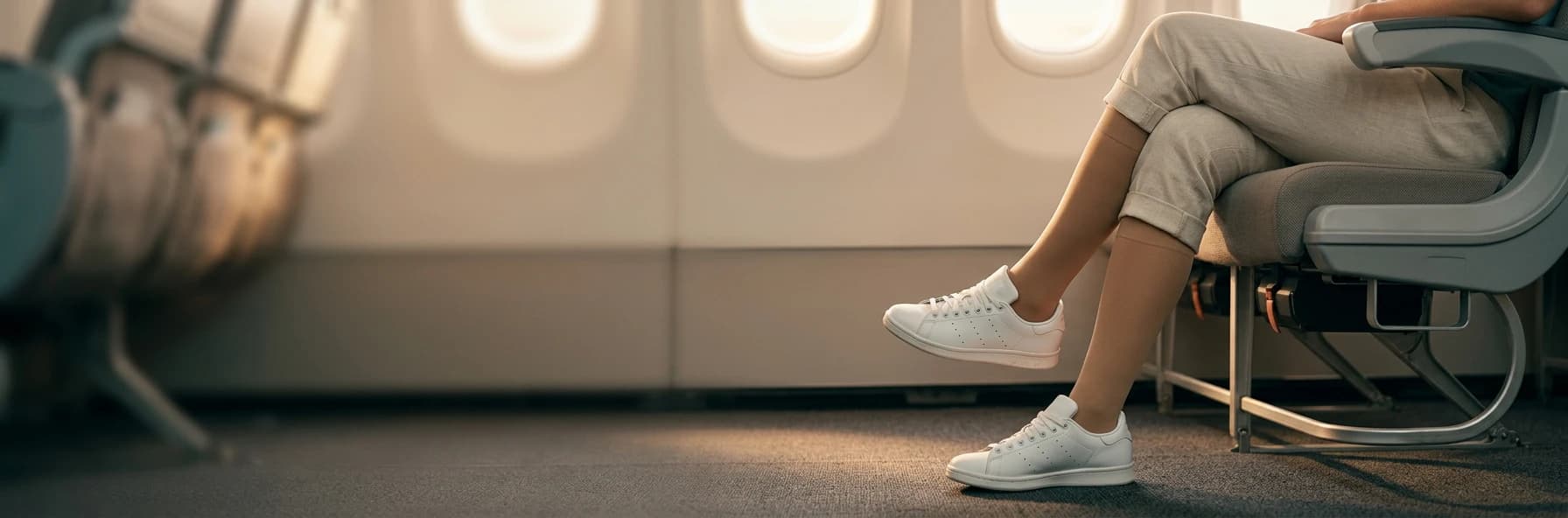
Firm Compression Stockings for Travel: What Strength Do You Actually Need?
If you already have vein problems and you're flying long-haul, Class 2 (23-32 mmHg) graduated compression stockings are usually the right strength. Here's how to choose between Class 2 and Class 3, and what compression can and can't do for you.
For most travelers with existing vein problems, firm Class 2 compression stockings (23-32 mmHg) are the right strength for a long flight or drive. If your doctor has already put you in Class 3 (34-46 mmHg) for your veins, wear that same strength when you travel. Don't upgrade strength on your own just because the flight is long.
Compression strength is a medical decision tied to your actual vein condition, not to flight duration. A stocking that's too firm for your legs is uncomfortable and harder to put on correctly, and a badly fitted firm stocking can roll or dig in, which defeats the purpose. Here's how to think about it properly.
Why graduated compression matters more than the number
Compression stockings work by applying the most pressure at the ankle and gradually less as they go up the leg. This graduated design supports the calf muscle pump, which is one of the main mechanisms the body uses to push venous blood back up to the heart against gravity. When you sit still for hours, as you do on a flight, that muscle pump barely engages, and blood has more opportunity to pool in the lower leg.
The compression class (the mmHg number) tells you how much pressure is applied at the ankle. It does not tell you whether the stocking fits correctly or whether it's graduated properly down the leg. A stocking that's the wrong size can still carry the right mmHg rating on the box and still perform badly on your leg.
Class 2 vs Class 3: how to tell which is yours
Compression stockings are generally grouped by class:
- Class 1 (18-21 mmHg): light support, often used for mild tired-leg symptoms or early spider veins.
- Class 2 (23-32 mmHg): firm compression, commonly prescribed for varicose veins and more pronounced venous symptoms.
- Class 3 (34-46 mmHg): maximum support, used for more advanced venous disease, as directed by a vascular specialist.
If you've been diagnosed with a venous condition, your doctor or phlebologist will have already told you which class suits your legs. That's the class to pack for travel. If you've never been fitted and you just know your legs ache or swell on long trips, that's worth a conversation with a doctor before you jump straight to the firmest option on the shelf. Our Maximum Support & Firm Compression Stockings range covers both Class 2 and Class 3 options, so once you know your number, it's a matter of picking the right style and fit.
Picking a style that survives a long flight
Firm compression is only comfortable for hours at a time if the garment itself is right for you. A few practical points:
- Knee-high vs thigh-high: knee-highs are easier to size and put on, and cover the area where most travel-related heaviness is felt. Thigh-highs are used when a doctor wants compression further up the leg.
- Closed toe vs open toe: closed toe is fine for most travel; open toe suits people who need breathing room or have sensitive feet.
- Fabric: a soft microfiber knit feels less bulky inside shoes than a heavier everyday knit, which matters more at Class 2 and Class 3 strengths where the fabric itself is thicker.
- Donning ease: firm stockings are genuinely harder to pull on than light ones. Products from the Easy-to-Wear Knit Compression Stockings line use a construction that helps the fabric glide on with less tugging, which matters if you're getting dressed in an airport bathroom before a flight.
If hand strength or flexibility makes pulling on a firm stocking difficult, a donning aid is worth adding to the bag. See the Donning N Doffing Aid range for options that slide the stocking on without you having to grip and stretch the fabric by hand.

What compression does, and what we won't claim it does
We sell compression garments. We're a retailer, not a clinic, and we want to be straightforward about where the line sits. Graduated compression supports venous return and is widely used to ease the heavy, tired, swollen feeling that long periods of sitting bring on in people with existing vein problems. That's a real, well-established use of the product.
What we don't do is promise that a stocking prevents a medical event. Thrombosis risk, and whether compression is appropriate or sufficient for your specific situation, is something your doctor assesses based on your health history, not something a retailer can determine from a product description. If you have a history of clots, recent surgery, limited mobility beyond just a flight, or any condition your doctor is actively managing, that conversation belongs with them before you travel, not with a sizing chart.
Washing and care, because firm fabric needs gentler handling
Firm compression fabric has more elastane woven into it than a light everyday sock, and that elastane is what loses its grip fastest if it's mistreated. A few rules:
- Wash on a gentle machine cycle at a maximum of 40°C. Hotter water breaks down the elastane fibers faster and the stocking loses its compression strength well before it looks worn out.
- Don't hand-scrub or twist the knit to wring it out. That mechanical stress on the fibers loosens the elastane faster than a gentle machine cycle ever will, even though it feels like the gentler option.
- Use a mesh laundry bag to stop the stocking tangling or snagging with other items. See Laundry Nets & Accessories if you don't already have one.
- Let them air dry flat, away from direct heat sources like radiators or tumble dryers.
If you travel often, it's worth having two pairs in rotation rather than hand-washing one pair in a hotel sink every night, which is exactly the kind of handling that shortens a firm stocking's working life.
Packing for the trip itself
Put the stockings on before you leave for the airport, not once you're seated. Swelling starts building from the moment you're upright and sedentary, and it's much easier to pull a firm stocking onto a leg that hasn't started swelling yet. For general travel comfort beyond vein-specific compression, our Travel & Flight Socks category covers lighter options for people without a diagnosed vein condition who still want some support on a long flight.
Common questions
Can I just buy the firmest compression stocking available for a long flight?
Not a good idea without medical advice. Class 3 is stronger, not simply "more protective." If your legs don't need that level of pressure, a too-firm stocking is uncomfortable, harder to put on correctly, and more likely to be worn wrong, which undoes the benefit.
Are firm compression stockings made to measure or off the shelf?
Most Class 2 and Class 3 travel stockings are ready-made and sized from a leg measurement chart, which works for most people. If your leg shape doesn't fit standard sizing well, or you need a different compression pattern than a stock stocking offers, a custom circular-knit option is also available. See Custom Circular-Knit Compression Stockings & Socks.
How long before a flight should I put the stockings on?
Before you leave home, ideally. Getting them on a dry, unswollen leg is far easier than fitting them once your legs have started to feel heavy.
Do compression stockings replace moving around during a flight?
No. Compression supports the calf muscle pump, but it works best alongside movement. Standing, walking the aisle when you can, and flexing your ankles in your seat all help the same mechanism the stocking is supporting.
المصادر
العبارات الواردة في هذه الصفحة عن الحالات الطبية أو العلاج أو التعافي مأخوذة من المصادر المنشورة أدناه. هيلفت متجر وليس عيادة — وطبيبك هو من يقرر ما يناسبك.
- 1.Venous disorders - Juzojuzo.com
يمكن لأخصائيينا المعتمدين إرشادك إلى فئة الضغط والملبس المناسبين.
تحدث إلى أخصائيمقالات ذات صلة


التعليقات
…