
The Complete Guide to Facial Lift Procedures: Achieve a Youthful Glow
Facial lift procedures range from a surgical facelift to non-surgical treatments, and only a qualified plastic surgeon can say which suits you. This guide gives a short overview and explains the face, chin and neck compression garments a surgeon may ask for after surgery.
Facial lift procedures range from a surgical facelift to non-surgical treatments, and only a qualified plastic surgeon can tell you which, if any, suits you. This guide gives a short, neutral overview, then covers the part we know best as a compression garment shop: the face, chin and neck garments a surgeon may ask you to wear after surgery.
The main options, in brief
These are the procedures people most often ask about. We describe them only so the terms are clear, not to recommend one over another.
- Facelift (rhytidectomy): surgery on the face and neck in which the surgeon works on the skin and the tissues beneath it.
- Mini facelift: a more limited surgical lift, usually focused on the lower face and neck.
- Neck lift and chin surgery: procedures focused on the neck, the jawline and the area under the chin.
- Non-surgical treatments: treatments such as Botox, dermal fillers and thread lifts, which do not involve surgery.
- Fat transfer: fat is taken from another part of the body, such as the abdomen, and injected into the face.
What each procedure involves, whether it suits you and what recovery looks like are questions for a qualified plastic surgeon who has examined you. Ask them about the possible risks as well as what to expect.
Compression after face and neck surgery
After a facelift, neck lift or chin surgery, your surgeon may ask you to wear a face compression garment. Whether you need one, which type, when you start and how long you wear it are all your surgeon's decision.
In general terms, a face garment applies steady, even pressure around the face, jaw, chin and neck, and helps keep dressings in place. What that pressure is meant to do in your case is something your surgeon will explain.
The face garments we stock
We stock three Revee face garments, all made in Italy from latex-free fabric, with Velcro so you can adjust the fit. You can see them side by side in our post-op face masks and chin compression straps.
- The post-facelift compression face mask gives full coverage of the face, chin and neck, with Velcro closures at the back of the head and at the neck.
- The compression chin strap for face and neck covers the chin, jawline and neck, for when your surgeon does not need full face coverage.
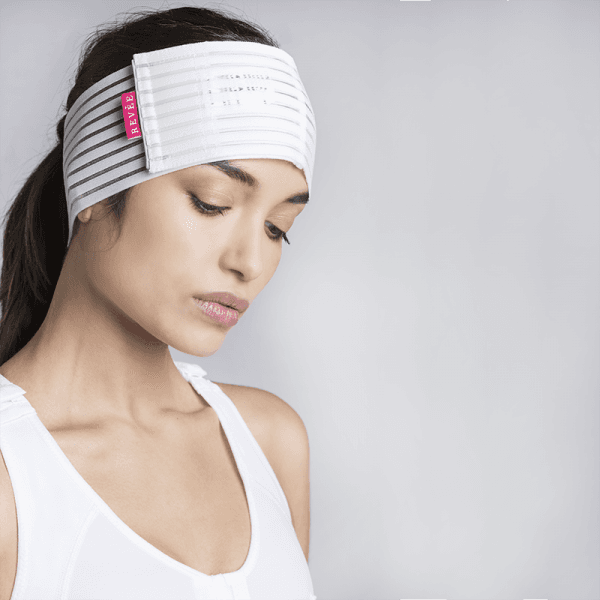
- The compression facial band is a simple elastic band worn around the head and over the ears. It is designed for wear after ear surgery (otoplasty) and as a lighter option after facial surgery.
If your surgeon names a specific garment or brand, bring the name or a photo and we will check whether we have it or the nearest equivalent.
Sizing and fit
All three garments are sized from one measurement. Run a tape measure from the crown of the head, down past the ear, under the chin and back up to the starting point. The mask and the band come in S (53 to 57 cm) to XL (68 to 72 cm), and the chin strap in S to L.
A good fit feels firm and even, without pinching at the edges. The Velcro should close with some room left to adjust, because swelling changes and you may need to re-set the fit. You should be able to speak and swallow comfortably.
If the garment interferes with breathing, vision or jaw movement, or if it feels painful, loosen it and speak to your surgeon. Always follow the wear schedule you were given.
What to ask your surgeon
A short list of questions before your procedure makes choosing the garment much easier:
- Do I need a compression garment afterwards, and which type: a full face mask, a chin strap or a band?
- When do I start wearing it, and do I wear it day and night?
- How long do I keep wearing it, and who checks the fit?
- If fat is taken from another part of my body, does that area need a garment too?
- Will the clinic provide the first garment, or should I bring my own?
Write the answers down and bring them with you when you choose. If you are asked to wear the garment day and night, a second one lets you change while the first is being washed.
Washing and care
Always follow the care label. As a safe rule, wash compression fabric in water no warmer than 30°C with a mild soap, and never above the maximum temperature the label gives. Close the Velcro before washing so it does not catch the fabric. Squeeze the water gently through the garment. Do not scrub it by hand, and do not twist or wring it, because that stress loosens the elastic faster than a gentle wash. Dry it flat in the shade, away from direct heat.
Common questions
Do I need a compression garment after a facelift?
Your surgeon decides. Many people are asked to wear one after face or neck surgery, but the type and the wear time depend on the procedure and on how you heal.
What is the difference between a face mask and a chin strap?
Coverage. The full face mask covers the face, chin and neck, while the chin strap covers the chin, jawline and neck only. Your surgeon will say which area needs compression.
Can I buy a face garment before my surgery?
Yes. Ask your surgeon which type they want, take the head-to-chin measurement and choose your size from the product page. Having it ready means you do not need to shop straight after your procedure.
Can Healfit recommend a surgeon or a procedure?
No. We are a compression garment retailer, not a clinic. Our team can help you choose and size the garment your surgeon asks for, at our shop at 610 Clover Bay Tower, Business Bay, Dubai, or when you contact us.
Our certified specialists can guide you to the correct compression class and garment.
Talk to a specialistRelated articles


Comments
…